Never This and That
You know this secret.

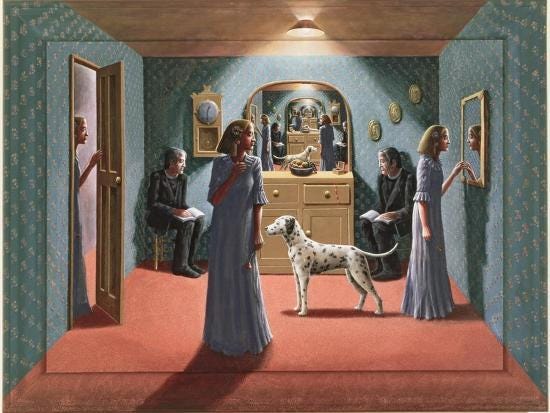
There is no one here.
This lone structure is little more than a clay brick in a scorched field. Its ample space is hemmed by a black gate. The sky above holds a pregnant pause and ten-ton, straw-colored clouds piled like behemoths. They threaten to come down, to reanimate all that grass and strike at those skeleton trees that jut in crooked reach.
The bedroom here holds little more than blankets eaten up by rot while the dripping walls hem around them tightly. In the closet, behind the sliding door, hangs a single green night dress. The bathroom is a pink tiled swamp where the tub has fallen through. One room hosts nothing but a standing lamp and a realistic plastic rendering of a dalmatian. In the one next door there is a hole in the wall, a pipe wrench stains the carpet brown. Little more.
Down the road where the earth turns flatter and brown there are machines behind barbed wire, lit up during all hours in painkiller white. Few workers labor there, the snore of pipes seers out on its own by the thousand.
Up the road, one week ago, no change in weather. Magentas and reds of dusk bled through the clouds. Three brothers at their father’s wake. They made up half of the attendance and the only that remained. Near the door, the eldest and the youngest spoke in knowing signal tones.
Every other noun was a knowing glance at their middle who stood a wall away by their father in his urn.
Gabriel James Gwynn, the eldest brother hissed his sibilance, tensing in the neck at the subject of their middle. For an atheist he held himself very much like a deacon with his brittle bird bones. His manner of dress was a measured arrangement: Modest, well pressed articles well tuned in humble browns. A satin vest and lily pin spoke of his reverence for mortal affairs.
A recent shift in behavior on an animal level. Something actively hidden. These were the themes on which he picked apart the topic of their brother.
Dalby McCoy Gwynn, the youngest, bobbed along with bassy cues of “mm”, “yep” and “definitely”. A bright red tie broke up his formal outfit which he had borrowed from his work as a porter. He found it to bunch up in itchy folds and longed to be back at his motel in a pair of boxer shorts.
‘Dear’ Aster Gwynn, the middle, could faintly hear this conversation but it did not entertain his attention. Nor did the task of mourning. He found death left not much to process. The cacophony that bared his father’s name had ceased. That was it. There was more to be said about a light switch. His dress shirt was black triangle print with a silver tone to match his off-brand wingtip shoes and dark hair greased flatly which was streaked by salt and pepper gray. Mushy snow come early.
He had reapplied his dark rounded glasses such that he could study the patterns on the ceiling whilst shielded from the one stark light which bled down dully white. It was all vines up there, painted in knots with sprigs of sorrel woven in their grasp.
His study continued as Gabriel cleared his throat pointedly “Good ceiling up there?”
Dear Aster croaked softly without moving his glance or shifting his stony frown “It’s doing its job.”
His older brother asked discreetly if he noticed Dalby to be acting at all abnormal or secretive. The answer given was a simple “No.”
When Gabriel pressed on, Aster slowly removed his sunglasses and stared at him with a single lizard blink followed by a softly breathless “I don’t care.” Which seemed to mourn the lack of a damn he gave.
Aster would have expanded on this to air his grievance that the two were typically abnormal if Dalby himself had not walked into the room.
The funereal space was modest in size. Walls papered in musty blue, arch shaped mirrors hung on every one of them in an attempt to portray vastness and a trace of the cosmic. The space was abnormally bright save for cutting shadows. A fat purple plum sat on the table by their father’s urn. A gossamer jeweling of condensation had formed the skin of its bloated flesh.
Dalby was practicing a trick shuffle with a deck of 52 “Gin rummy?”. He felt something crunch under his foot and looked down. Broken crystal glass.
Gabriel: The three of us? How?
Dalby: Pair up and rotate the dealer.
Aster: I’ll deal.
The trio made a circle on the wall-to-wall carpet, taking care to stay low as to avoid the telling play of mirrors. Aster dealt his brothers in. Gabriel mixed three cocktails at the drink table. These were chilled pours of bitter herbal spirits of a nearly phosphorescent green in crystal thimbles with narrow stems.
Aster: Which cards do you want?
Dalby: Uh… The really good ones. You know, King, Queen, Jack, all the same suit.
Aster: That’s a good choice. Gabe should have thought to ask.
Thunder roared like a timpani drum in the darkening sky with no trace of rain to quench the battered land. Dalby looked over his cards.
Dalby: No, I said the good ones.
Aster: You should have made me a cocktail.
Gabriel: It’s your turn.
Aster: Alright, the rule is that the winner of the tournament is the next one to die.
Gabriel: Elaborate.
Aster: I’m letting dad win by default since it’s his party.
Dalby: Checks out.
In spite of his spoken bluff Dalby’s hand held a promising run. 1, 2 and 3 in the suit of clubs. Gabriel rose to seek out the restroom, insisting that Aster watch over his cards. Aster approached their father’s urn and lifted the lid “Oh, here, dad can watch them.”
Gabriel bristled “DO NOT PUT THEM IN THERE.”
Dalby arranged his cards and listened to the eldest’s muted footsteps as they vanished down the hall. Once they had stopped he glanced over to his second-born dealer.
Dalby: Does he seem like he’s acting kinda different to you?
Aster: Gabe’s always different. He’s not himself when he’s the same.
In the washroom Gabriel splashed cold water on his bony face, letting it drip down off his hair into the sink before taking his comb through it.
Dalby: It definitely seems like he’s got more of a rod up his ass than usual. Maybe keep an eye on him. I don’t know how much he’s not telling us.
Aster agreed but could say the same of Dalby himself who pressed on, asking where the eldest was staying. Aster described the brick shaped house. His younger brother looked scandalized “He said that’s where you were staying! I even drove by to see if it was true. I didn’t see anything for miles, it was weird out there. You know how it is, I feel like people just make up weird things when they don’t know what’s up.”
Aster: A lie’s just the truth in its Saturday pants.
Dalby: Sure… Yeah. Hey, do you think Gabe might…
The subject was dropped when Gabriel returned to reclaim his bitter solution by the stem of the glass. Aster dealt him back his cards, untampered, and the trio played were about to play on when a diplomatic register took over the eldest.
Gabriel: So Dad didn’t leave any one of us anything after he died, right? Can we at least be clear on that?
Gabriel dropped an eight of diamonds on the discard pile.
Dalby: Yep.
Aster: He had nothing to leave us other than a bunch of tax debt.
This was true.
Gabriel: Okay that is good to know, because I know you guys were the favorites. It’s no surprise he had nothing.
This remained to be seen.
Dalby: Yeah. There’s really not a lot more to it.
This was false.
Aster: There was one thing in particular I thought you could explain to me.
Dalby: Yeah? What was it?
Gabriel: Which one of us? You’re looking at the ceiling.
Gabriel gingerly discarded a four of spades.
Aster: It’s hard to say now because the order of it changed. Dalby used to know what came before it.
Gabriel: In the game?
Aster: No. This topic was before the game. It was the next thing but something nudged it along and another became the next. You knew the next one before. That’s all that I can say.
Gabriel: I.. don’t know, that’s a little vague.
Aster: Unrelatedly, what time did you arrive?
Gabriel: Don’t ask questions you know the answer to. You’re trying to draw something else out of me.
Aster: Dalby, I think you can help here. I know the order of it but the order of it changed. It was the next one but it’s no longer next, it got… Nudged along. So it’s not ‘it’ anymore. Does that make sense? That’s all I know.
Aster glanced at Dalby who noticed Gabe growing more clenching his jaw as he folded his cards into a tight little deck of their own.
Dalby: Oh… No, yeah, yes. It did change. Did Gabe not explain that to you?
Aster: He definitely did not explain.
Gabe stared up at the ceiling, mouth ajar as if gathering the last of his wits through a growing heat. He placed his cards down in an orderly pile and clapped his hands together, opting for a sharp turn.
Gabriel: So did Dad say anything to either of you towards the end? For me he made no effort to reach out.
Not that I would have picked up the phone, obviously.
Dalby: Yeah, I visited him a month ago but you know, none of what he was saying made any sense.
Aster removed his sunglasses, placed them on his knee and utilized their lenses as a makeshift looking glass in which he could style his hair. He pasted at a few odd strands. Following this, he examined his frown from two separate angles.
Gabriel: What did you think of what he said?
Dalby: I thought ‘What the hell?’
Gabriel: What was the hell.
Dalby: I don’t know.
Their father had called Dalby in for a visit when he was little more than a proverbially toothless afterimage of his former self. The old patriarch at that point looked like something that had come from a can, preserved in cloudy brine. Like any dying animal he gravitated towards the corner of the room and only moved to use the bathroom. His eyes struggled to focus and lolled as if loose in their sockets. Around his face sprouted irregular tufts of hair. Little was said beyond fragments and a twinkle eyed promise that they’d all meet again. “…And again and again if the weather is good.”
As his brothers quibbled, Aster noticed something above the door. It was a painting, mandated by their father’s will to be hung at the funeral. The work was titled “The Animal” and portrayed a skulking black jaguar rendered as equal parts liquid and predatory.
At its feet were the ruins of a nest of birds, half formed babies strewn around from shattered eggs, parents reduced to crude bones and feathers. The eyes of the beast pointed in no particular direction and only portrayed, in brutal clarity, their own primal form. Two black dots of nullity. Something began to make sense.
Aster thought that if stones could hallucinate they would extrude an animal like that. But a predator needs something small to follow through the night so there may have been a boy. If there was to be a boy he would need parents and aunts and uncles and all sorts of other named and nameless bodies reared up groaning from the restless earth.
And the boy may grow into a man whose tooth may fall into the woman’s gut and there would be the child. But the child cannot see itself without a brother but the two could know themselves without a third so the tooth splits in three and the one cuts pieces from two cuts pieces from three cuts pieces from Gabe cuts pieces from Aster cuts pieces from Dalby swallows Gabe swallows Aster swallows Dalby and the old decrepit man peeks over the hill smiling, he is smiling, smiling in ecstasy and agony while the tortured machine churns away with all its wilted vomit songs.
Dalby: Gin rummy.
Gabriel: No way. No, I was watching the discard pile. There’s no possible way…
Dalby laid his cards down plainly.
Gabriel: Hmm… Okay. You’re sure you didn’t overdraw at some point?
Dalby: Positive.
Gabriel: Alright, fine, I’ll let you have that. You want to shuffle again so I can deal Aster in?
No response. Aster kept his gaze far away, transported by the painting to a world where all was clear.
Aster: What were the two of you doing before the funeral?
Gabriel: Have you considered that you might be a narcissist? You’ve been pressing on things lately that I really think only matter to you. The room is filling up with what you’re not saying and it’s just strange to me that you need that.
Dalby:…Preparing for the funeral.
Aster: Do you remember this morning?
Dalby: Well, I’m pretty sure the sun came up.
Aster: Right, but do you remember it?
Dalby looked down as if pained deep in his guts.
Dalby: My pockets were full of dirt.
Gabriel: What?
Dalby: What?
Aster: Do you remember Dad’s cremation?
Dalby: I wasn’t there. Only Gabe was there, I told you that.
Gabriel straightened himself and cleared his throat.
Gabriel: Dalby, it’s your turn again.
Silence. With a dead smirk Aster tossed his head back as his eyes grazed to his attention to his dealer.
Aster: Has anyone said that of me? That I was the only one there? …….Did you know that they scream when you cook them?
Dalby: Soul has to come outta the ass sometime. If it doesn’t come out people explode…
Aster and Dalby joined in unison “…Like popcorn.”
Aster: I know. We know that the soul has to come out of the pants or else popcorn. It’s wonderful.
Gabriel: That’s a known phenomenon, it was gas escaping. It really doesn’t matter who was there, the man was burned. He’s just powder now. And yeah, fine, I may not have been there. For all I know Dad may not have been processed into ashes. I don’t know why we have to tiptoe around it even. Was that the big secret?!
Aster: No.
Dalby: Absolutely not.
Gabriel: Would you like to air it then?
Dalby: Only Aster knows about it.
Aster: Who now?
Gabriel: You both know, you’re entirely full of it.
At this point Dalby walked roughly halfway across the room, picked up the third chair from the center row and scooted it two feet from where it sat before returning to his place at the card game. There was no reason for this.
Aster: I’m not sure what I know here.
Dalby: I don’t have to tell you, you know already.
Gabriel: Is it about what happened?
Dalby: Why are you pretending not to know at this point?
Gabriel: Ok. WHAT IS ONE THING WE ALL KNOW about the secret?!
Dalby: That there is one.
Gabriel: What would it be like if there wasn’t?
Aster: What do you think would happen if I broke this glass?
Aster finished his cocktail and raised the glass in the air, rotating it back and forth by the stem as a ray of light glinted off its curvature.
Gabriel: Again?
Aster: Again?
Dalby: You’re breaking it now.
Dalby was entirely correct. In his rigid grasp the stem of the stylish piece of crystal glassware had broken. Aster dropped what was left of it on the floor. All three heard the glass shatter. Aster dropped to his hands and knees, examining the ground “Where’d the pieces go?”. Gabriel pointed back to the drink table “It’s over there. You must have broken another one.”
Aster: Which one?
Gabriel: The… One that you broke.
Aster: I think I have to eat the glass.
Gabriel: No.
The youngest hoisted his body up from the cards, bracing his hands on his thighs.
Dalby: Okay… This would be a great time for all of us to leave. I think that’s our cue.
A muted, repetitive thump hammered through the room.
Gabe looked at Aster who looked at Dalby who looked at Gabe. All three synchronized. First their gazes twitched to one another then slowly righted themselves in the direction of the sound, all with uncanny synchronicity like the resonance cymbals in reverse. At that moment the hands of the clock seemed to slow like flies in setting aspic and the shadows stretched a tad longer in their glide across the floor.
The noise had come from the far wall. All three stood up and approached. Dalby put his ear to it and dragged, feeling along with both hands for the slightest vibrations. Another sound, this time distant. It led him to the mirror which he peered behind. Without a word he began to lift it off the wall, motioning Gabe for a helping hand.
Behind the mirror there was a nearly imperceptible crease in the wall in the shape of a square. Aster took his pocket knife and pried it open, the hinged panel revealed a dark rectangular space which stretched well beyond where their intertwining gazes could reach. Dalby kept his ear pointed down the space and held up a finger to shush his brothers “Do you hear that? ……What is that?”. His brothers could hear nothing but the hum of air conditioning.
Aster felt the walls, finding them to be made up of smooth, cool stone. When he pinched and rubbed his fingers together he was met with such familiar texture that he did not question their lack of dust. He and Dalby conferred about the possible purpose of the space and origin of the sound. Maybe something had crawled in and finally died.
Dalby called in “hello” and was greeted by an echo. His voice multiplied, splitting off of itself into an unintelligible mass. His word sounded down forked corridors and little square chambers, down tunnels and valleys. It sounded out through the hole in the wall right here in this brick shaped house, traveling through every empty room until it settled in the walls. In the bedroom, between disintegrated sheets, something stirred.
Gabriel saw something. What did he see? Something moving. He reeled back, sputtering a riot of curses and stumbled over a wooden chair, his long limbs flailing. Startled by this, his brothers quickly bounced their gaze between him and the space.
Nothing there.
Gabriel caught his breath and frantically commanded his brothers to close up the space again. Their interest was more in why their eldest had broken. In spite of many questions he would never come to explain what it was he had seen. At his insistence the card game continued. Aster smirked below a heavy brow.
Aster: Did you think it was me crawling out of the oven?
Gabriel: What?
This remark was in reference to an incident from their childhoods. Aster often had trouble remaining still. One day he snuck out to the garden with the aim of engaging in a particular ticcing and a cracking of his joints which his father had forbidden. First the neck, then the shoulder, onto the spine. This repetition of motion yielded a profound sense of calm.
When they reported their brother’s actions to their father he responded by leading Aster to the kitchen. He shut off the gas on the oven, filled his child’s mouth with dish soap and put him inside. The arrangement was that he could be let out and spit out all that soap if he could go without moving as his father counted to an unspecified number.
Through his counting there were increasing interruptions of berating and profanity. These grew louder and more frequent until he had worked himself up into a screaming lather, pounding at the metal walls of Aster’s enclosure as his brothers watched. His heart gave out in a way that could have killed a lesser man. In the absence of his father’s counting Aster began in his head.
Dalby looked equally puzzled by this reference but took little notice as he discarded a jack of hearts.
Dalby: Did you see what you’ve been hiding in there?
Aster: Or what you thought we had been?
He looked up to see that the eldest had picked up his glass and placed it on the table. His voice cracked across the room.
Gabe: No… No it was something else.
Gabe left without a word further. Dalby soon followed. Aster lingered. He approached the urn and gingerly removed the top. Nothing inside. Aster retrieved the knife from his pocket and cut into the plum on the altar. It bled and stained the cloth. He made for the exit and vanished down the dark road.
All was still for a moment and a half. But soon the rosy stain of juice reversed its course through the fabric and the cut segment gradually began to tremble until sticking itself back onto the whole and sealing its seam until the lustrous peel was featureless again. First, its former dewdrops on the surface reappeared only to become finer until the misty coating was gone by reverse accumulation.
A pale hand reached out from the hole in the wall and closed the panel. With the sound of air sputtering from a balloon the clocks ran backwards like arms twisted wrongly. Moments afterwards, a funny thing happened: The funeral service began again. Gabriel entered, Dalby followed and asked how the trip out had gone before finding a deck of cards left on the floor. He examined the deck, wondering where it came from and tried out a shuffle he had learned.
Aster entered and sat, this time opting for a seat in the back. He trained his gaze on the plum on the alter. Yes, perfectly intact. He clasped his hands and stared at the space between his shoes. He knew the his next course of action, it left little to consider.
Two days later, no change in weather. Aster arrived at the brick-shaped house looking worse for the wear. He tested the door, finding it to be unlocked and let himself in. Once inside he called out “hello” to no response, as expected.
In spite of this he found the electricity and gas hooked up. These were decent accommodations for a place in which no one stayed beyond passing allegations. Finding a feral hunger to be nipping at his heels he pulled some vegetable matter from the soil, roots and all, and threw it to boil in a scavenged pot. He stared at the fragments of dirt as they bubbled out to from the wilted mass to break into a fine black substrate through the roiling steel cavity. Aster could watch water boil any day and all night.
When he attempted to sleep he found his mind to be ticking away with that feverish logic of half dreamers. Images flooded of throbbing veins branching off in limitless turns. In passing glimpses saw his two brother’s faces looking back at him.
He was woken up by a voice. It said nothing. It only counted. The voice was not deep, nor high pitched, not loud nor inaudible. It was like no voice Aster had ever heard but it was not by any means unusual. It was an empty voice, like a dead mouth firing blanks through novocaine. Counting.
Had he left the TV on? There was no TV. He would not have watched it if there was. He traced the voice as coming from the far corner of the house. As soon as he was out of bed it ceased. He made a guess as to its room of origin and opened the door to find nothing there.
It brought to mind a story his father had told him. The last time Aster met with the old man he shared what at the time seemed only to be a musing from his medicated delirium.
“When I was a kid my parents were often not happy with me. It got to a point where my mother had badgered my father with stories of disrespect until the man could take no more. He came home in the wake of a ten hour shift, walled me up in the crawlspace and dragged the refrigerator in front of the door.
During my time inside I would count endlessly. I’d count by twos in rows of three, by threes in rows of two, backwards from ninety nine ninety, nine times in pairs of two and three. I’d imagine all sorts of things without trying, for example that I was in a vessel under miles of cold, dark water or that I had my own house with my plenty of sons, a wife like the women on TV, my own house, my own dog…
It must have been weeks there in the dark. I realized that I was going to starve in the filthy place so I had nothing to do but sort things out. So I crawled further in. That’s where I found the real truth of things. I realized that what I had always thought was real life had been only words and silliness.
There was never any such thing as weeks or other such things. I may have died in the dark as a child but that’s all nonsense, a bunch of narrative anyway.”
His father hacked up a mass of something thick and settled again as his eyes looked at nothing.
“I learned to play with time in a certain way. And I sired three beautiful boys like any man, boys of my own flesh and blood who would never leave me. All together, hand-in-hand, the music of skin.”
Words such as these had been playing through Asters mind in the abscence of others. It had been a quiet time and his mind took time to snap back to a world without words. He spent his time in the house burning little of the oil left inside him. He’d stand planted, watching the change in direction of shadows throughout the day. Once the sun had left of itself only afterglow he’d pour himself a glass of water, walk across the house and take a single sip before abandoning the cup to become a vessel of stray dust.
After the brothers had dispersed from the funeral home, Aster was able to narrow down where Gabriel was staying. So empty out there, it could only have been the quaint white cabin under tall trees by the quarry. Outside, he triggered his older brother’s car alarm, sending him running out to stop it. Crucially, the eldest brother had left the door open. Gabe returned to find that the lights had all been turned off. His younger brother had moved so quietly.
When Aster brought a pipe wrench down on his head he dropped to the floor, convulsing like a pulled-off lizard tail. Gabe stood up, head wound and all and looked his brother in the eyes. He tried to go about his life, not sure what had changed. He attempted to ask his brother something but found his words only twisted and fell in a heap. He took to the fridge and poured himself a glass of milk only to collapse again. His head turned restlessly in the pool of milk. Gabe spoke one more time, an attempted confession. Dear Aster finished him there.
On the following night Aster called Dalby, saying he had finally figured out where their older brother had been staying. This was true, the address he gave was false. With the intention of finally sorting things out Dalby drove to the industrial corridors and waited. He was puzzled by the location but found himself compelled by his brother’s steady conviction.
Aster stepped out from a dark alley with a serene face that shined like a theatre mask in the cold light. He beckoned his younger brother out of the car. The two conferred on the topic of secrets. Aster told his younger brother one and said it was alright that Dalby shared one with the eldest. Dalby, always eager to get to the heart of things, asked his brother where they were going. Aster pointed past a chain link fence “Right there.” As his brother squinted into the landscape of concrete and metal, Aster took a box cutter from his pocket and slid out the blade without a sound.
All was said and done. Aster crawled through the hole in the empty room. Deeper and deeper down he found it branching. One mile into the chambers he saw what looked like statues of the three, fused into their surroundings. Copy after carbon copy of Gabriel, Aster and Dalby. As he crawled deeper he witnessed earlier phases of mineralization until these forms were only naked bodies, some still moving.
Soon after, Aster found what was left of his father, little more than a gray wrinkle. The old man smiled until his son broke his neck underfoot, ending that life for the very last time. The old man could do anything but even anything comes to an end and everything has one.
Further down he shedded his clothes and curled up at the bottom for his last mineral sleep. Down there at the end he whispered a secret.
This, at the end, was the way of things. The stones, ever-restless, dreamt of flesh and blood. Things wriggled out under deep red skies through the cracks. They crawled on four limbs, walked on two, and believed all manner of things. The stones in their turn are built of those that walk and all that is real is an animal sealed in a little glass box of itself swallowed up by the animal sealed in the little glass box swallowed up by the animal sealed in the little glass box. These words may be questioned.
The three men passed altogether but not at once. Some nights in the flat brown lands where the machines run themselves, passersby would see three naked figures on the ground. These orphaned things crawled in a facedown drag, limply shrieking to each other in some private tongue. Their pale bodies moved with near weightlessness, like paper refuse by the subtlest winds. Reports were left cold of two brothers murdered and their third gone without a word.
Other nights they’d see the a light still on in the window of this house or Dear Aster Gwynn standing out in the yard. Without exception the man would vanish in the rearview. Now there is no one here